Saturday, July 17, 2010

Children’s Balinese Dance Lesson


July 10, 2010


Of all their recommendations of what to do in Bali, Harvey and Mary insisted that we had to get the kids a Balinese dance lesson. It took some doing, but turns out the local Ubud kids have a dance lesson every Sunday morning at their village temple. Griffin refused to dance. He’d be the only boy, he said. It’d be too girly. He just plain didn’t want to dance.


Alice, on the other hand, was completely willing. Our guide, Agung, knew the dance teacher and asked if it was okay if the kids join in the village dance class, even without wearing sarongs. If you read our earlier cremation blog post, you’d know that we were completely clueless over when sarongs were truly required for proper religious respect, especially at a shrine. The Balinese dance teacher, well-known for his specialty in the aggressive male warrior dance, kindly said no sarong required and took our kids under his wing, often speaking in English, rather than the typical Balinese instruction, just so our kids would understand.


Alice, a bit nervous, joined with the girls for their dance lesson. All the girls in her class were either younger than her or the same age but shorter. Each time the female dance teacher would give a command, she’d physically demonstrate it, holding her arms and legs up high in an awkward, often twisted, position, moving her head and eyes from side to side, sing a little Balinese dance tune, then ask the girls to do it. Each time she told the girls to try it out, she’d carefully readjust Alice’s position. She made adjustments that we just couldn’t understand. It was like watching an American football player trying to learn ballet. The cracks in Alice composure started to show.


The boys walked in. Lots of boys in sarongs. I watched Griffin take them all in, noticing how athletic and cool they looked. After he had previously refused to dance (which led Boom to promptly refuse to dance), he was now willing. And, Boom said “Me too!” The instructor taught them little steps with the ultimate goal of acting out a fierce warror dance, with eyes shifting to the right as their bodies went to the left. Griffin tried so hard. Boom tried too, watching the teacher, and especially Griffin, carefully -- largely raising his shoulders and stomping in the same general direction as Griffin. Griffin and Boom looked more like Tentative Warriors than Fierce Warriors.


Then, they watched a senior boy get taught by the instructor. The senior boy is going to a Bali-wide competition, and he is Ubud’s entrant into the competition. Kenny and I got so caught up in watching Griffin and (laughing at) Boom that we’d forgotten about Alice, in her class in the adjacent courtyard. When we peeked in on her, she was sobbing by the side of the class, being comforted by a Balinese mom. Alice had freaked out when we’d left to watch the boys, not being able to find us. She sat out the rest of the class. Alice said she was “terrible” at Balinese dance.


In the end, Griffin had to be nearly dragged from the boy dance class, with the instructor pointing at Griffin saying, “That one has real talent.”

Monday, July 12, 2010

Catch Up


Hi all - Ken here. Colleen's a little behind on the blogging, mainly because we had lousy internet in Bali. So here's a little catch up (I'll let Colleen add pictures later):
1) We stayed a week in our hotel in Kuala Lumpur and found out that even though we successfully rented a nice apartment beginning July 1, we couldn't have furniture delivered until July 8. My wife's solution? The trip to Bali for a week (which was amazing, even Ken the cynic must admit).
2) Bali is entirely Hindu, even though the rest of Indonesia is muslim. The people, as a result of their religion I believe, are incredibly nice. Very spiritual, constantly partaking in prayer offerings to the gods and participating in ceremonies at their many temples. Every house has a private temple built in, and you walk around in the morning and each little statue has some rice, flower petals and smoking incense, each offering and statue with it's own special purpose. Incredibly confusing to follow, but the result was a kind, peaceful gentle people who were pleased when fat, ugly Americans wanted to participate in their rituals.
3) Colleen makes a lot of plans. I've given up fighting those plans. So when she signed us up for the "Eco-Tour" on some island, where you get to live like a real villager, I didn't fuss. When I finally checked the guide book it said "If you're going to go on one expedition, make sure to go to Lembongan Island." Only problem was, we were going to Cennigan Island next door. It turns out the villagers' life, and Eco Tours, kinda suck. Apparently in 1984 a Japanese man showed the villagers how to farm seaweed, and they've all made a living doing that ever since. Seaweed really smells. We were in a cramped, hot, fanless room adjacent to some of the largest ant colonies known to man, on top of the only road. Whenever a motorcycle roared by (often), it sounded like a DC-7 landing in our living room. Every time we wanted to go anywhere, the guide had to run around and try to find 3 villagers with motorcycles willing to give us a ride. On the plus side, all of my kids got to ride on motorcycles without helmets, which they thought was pretty cool, and the snorkelling was amazing.
4) Approximately 8 times in the three weeks we've been here, people have stopped us on the street and asked if they could take a picture of them standing next to Abraham. It happened again today with people from Bejing. I'm convinced he's the next Dalai Lama.
5) Malaysians do not use mustard, decaf tea or ziploc bags. They do have 20 different types of dried fish.
6) Nanny, Papa, Uncle Patrick and Brendan have arrived. The kids are in heaven, and even I get occasional half-time kid duty as a result. Also, Pappy and Brendan reminded me that alchohol is an important part of vacation. Nanny and Papa have struggled a bit with the time change, but that's to be expected, and we're all looking forward to 10 days in Penang and Malaysian Borneo. We will have stayed in our apartment exactly 5 days since our last trip. Whew! -ksf.

Bali: Batik-making, with some jewelery-making as adornment


Isn't Ubud remarkable, having earned its moniker as the cultural capital of Bali? In addition to the kite and woodcarving, they have jewelery-making and batik-ing. We didn't even get to see the stone carving and more...

Above, you can see the hot wax the women used to create the batik prints. There was also hand-weaving of textiles there. Then, Alice and I shopped til we dropped for batik clothes.

Alice reaped the benefits, adorned in her first fancy earrings and batik dress.

Bali: Kite-making


e


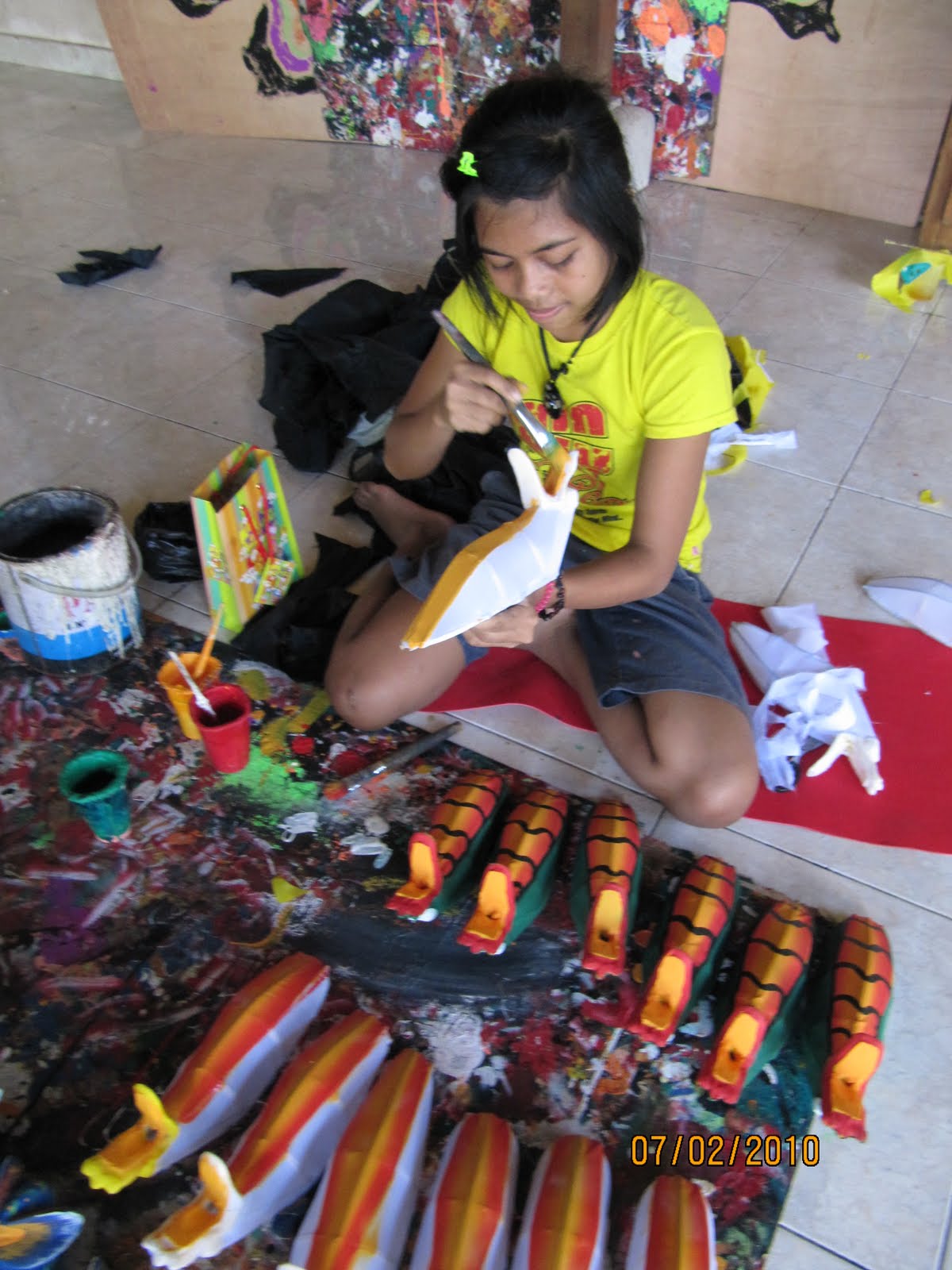
Agung, our wizard of a guide, next took us to a kite-maker outside of Ubud. I walked in with the mindset of a capitalist -- expecting a businessman plying his wares. But, this was no ordinary kite-making business. This businessman said that once he embraced a Hindu ethic in his work, he wove environmentalism, kindness to others, and sharing joy of creation and kite-flying.

Environmentalism came from his styrofoam used for the kite animal heads he carved. See the picture above for Ken holding up the styrofoam the kite-maker collected from discarded mattresses after a big hotel fire. You can see that the kite-maker showed Griffin how he carved out an owl face for his owl kite.

Kindness to others came from when he started training new kite-makers from villages all around Bali who then sold their kites via the kite-maker, in a sort of kite-making cooperative. He's trained and helped develop 200 kite-makers that way. Everyone at his worksite seemed so happy. There was a very disabled man working there who seemed to have found his place in life.

All the kite-making at his studio happens right next to his Hindu shrine where his guru's photo is placed prominently, even among the kites for sale in his front showroom.

After listening to the kite-maker's story, Ken, the cynic, told me he may become the first Hindu Jew.

Sunday, July 11, 2010

Bali: Woodcarving around Ubud


Agung, our tour guide extraordinaire, took us to a little town outside of Ubud, the arts and crafts capital of Bali. In this woodcarving town, he found a hidden courtyard with woodcarvers wielding animal carvings. Agung took us to this place since he knew the woodcarvers would be willing to teach the kids how to carve.

Griffin made his first woodcarving, with a mallet and chisel, producing a Buddha...with a little help from the carver. Grif now meditates with his Buddha in front of him. Boom and Alice were relegated to the lower status sanding duties, but seemed to relish sanding their ducks anyway.

How could we not buy something after they gave all that attention to our kids?

Bali: How to Handle the Heat


Bali: Cremation


On our first day in Bali, we were leery about attending a Hindu cremation. It wasn't just the morbid reality, but it was this sense of our crashing someone's intimate family funeral. A time for personal grieving.

Intimate it was not. And no one cried. It was so un-intimate that the moment we stepped out of the car, women swarmed around us, aggressively wrapping sarongs around us, insisting that they were necessary to attend a cremation. It would be sacrilegious without them, they argued, trying to make us buy $3 sarongs for $20 each. We righteously refused being taken advantage of, then had second thoughts as the throngs heading towards the ceremony were covered in sarongs, even foreigners like us wearing freshly-bought $20 sarongs.

We were soon lost in the crowd, invisible foreigners, lining the crowded ceremonial procession route. No one was thinking of sarongs, we soon realized, they were just focused on standing in the shade and surviving the blistering heat. And, standing, and standing, for what felt like hours. At one point, I felt dizzy and just sat on the ground. We didn't have any food other than nuts, which we devoured having had no lunch, as we watched woman after woman carrying delicious food covered in flowers. We then ran out of water.

All the while, we watched as they scrambled to coordinate hundreds of people to make the cremation procession happen. Why was the cremation so huge? It was for the "queen," we were told by all the locals. The queen was a ceremonial leader of the local region, having been a real ruler before Indonesia nationalized all its 17,000 islands, combining them into one territory. She was Brahmin so everything was in white. Lower caste cremations are in red or black.

After the long wait, the gamelan players got in place and started playing. It was transporting, focusing music. Everyone seemed to know the tune. Then the procession finally started moving. Everything was carried by hundreds of men using strong bamboo poles to carry everything -- gamelan instruments, drums, beautiful young ladies holding up flowers and food, Hindu god statues to ward off evil spirits, and, at last, the coffin, walked up many white steps to the top of a decorated tower with a priest and coffin pallbearers, at least of them carrying a complicated set of bamboo poles to somehow, impossibly move the huge tower and coffin along the long procession.

We were enthralled. And thirsty. And hungry. Once the procession passed, continuing onto the cemetary for the burning of the tower and coffin, they planned to set the burning coffin on a float and push it out to sea. All a lyrical, spiritual burning to watch, filled with meaning.

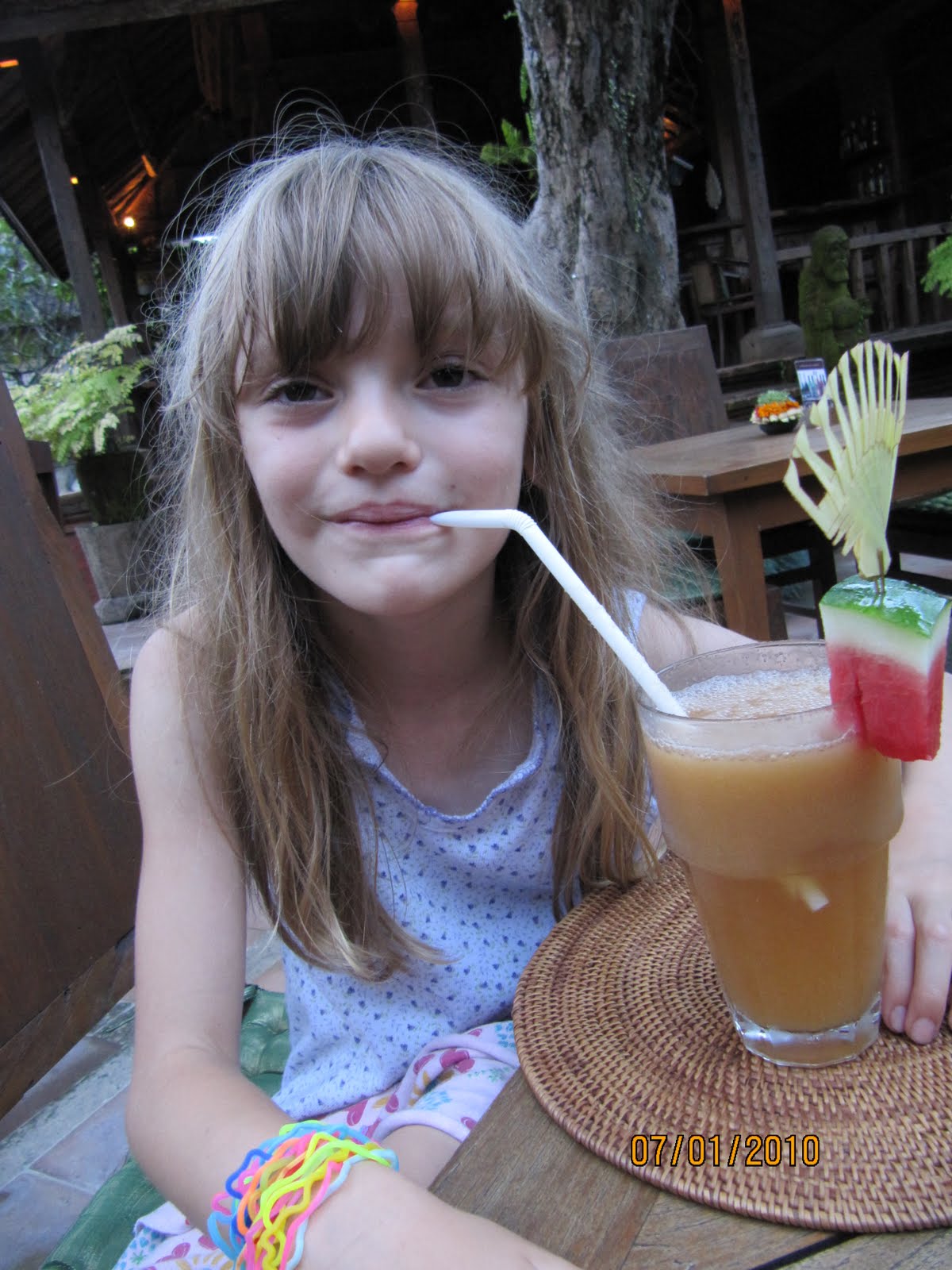
But, we passed on it. Moving on to fill our bellies. Back to town for freshly squeezed juices. Feeling very much alive.

Saturday, July 3, 2010

Batu Caves Hindu Temple in Kuala Lumpur


Before going to the Batu Caves, just north of Kuala Lumpur, we heard a lot about the 272 steps and not to touch the monkeys. The caves are a sacred place for Hindus, and Hindus see monkeys as sacred so let them run wild and free on the steps up. What we didn't hear about was how there are temples for Hindus at the bottom and in numerous spots in the top. In these temples, the Hindu priests were topless, with white paint on, performing rituals with much incense, singing, and playing instruments.

The monkeys were bored by us on the way up. The kids made it up the steep steps to the top where they were rewarded by beautiful, wet, dripping caves filled with incense, natural skylights, and the main temple.

On the way down, Ken asked me to help one of our kids down the steep steps. My kids ended up helping me down, since I was barely keeping a panic attack at bay over how steep and long the drop down seemed to me.

Elephant Sanctuary


At first, Boom was completely scared of the incredibly tame orphaned elephants at this Conservation Center outside of Kuala Lumpur. Even before we left the hotel, he dropped to the floor and threw a tantrum, "I don't like Elephants!" You can see his pulling away from the elephants above. But, after numerous attempts by me to get him accustomed to my feeding the elephants, with no success, Ken did his magic and somehow coaxed Boom to ride an elephant with him.

The Center is funded by money from visitors and private donations; elephants are driven out of their Malaysian jungles by overdevelopment, especially of palm and rubber plantations. After the farmers or poachers attack the Elephant families, they are often brought here. One elephant's foot was amputated by a poacher trap and he limped around until a donor got him a proscetic limb, which was so touching.

A handful of the elephants have to pay the price of our riding and bathing them daily. And, feeding them cucumbers, watermelon, grass, and peanuts, as you can see from the video of Griffin feeding them. I put the cucumbers directly onto their tongues and, let me tell you, their tongues feel as soft as wet silk.

While us Americans, Australians, and Middle Easterns watch the elephants, the local kids living in the jungle, above, watch us.