Friday, December 31, 2010

Siem Reap, Cambodia: Floating Village


Fishermen hitting the net to sift out the remaining tiny fish, stuck in the net.


The animist spirit house.


December 26, 2010

It was good to see our guide, Ken Ha ("Nya"), again after I last saw him a few weeks ago at my Angkor Wat half marathon in Siem Reap. He toured us through the Siem Reap floating village on a boat. Right now, the village is barely visited, where we toured, but it's getting overtouristed in parts and we predict this area will too. But, for now, it seemed nearly untouched and we got a taste of life as a floating villager. Click video here to get a taste of the floating village.

They are nomad fishermen, changing location depending on the monsoon season. The lake is huge but still quadruples in size whenever the monsoon rains hit, and the villagers float all over depending on where the fishing is best. They mostly use nets and you can see the picture above and click the video here to see them use large hoop tools to swat at the nets to break the smallest remaining fish free of the net.

They have an animist spirit house (see photo above) where they climb up to the top to heal people, calling the spirits of the river, fish, and other parts of nature. They still practice Buddhism at the same time. A small minority practice Christianity, but I'd say that's a super small minority, as Christian missionaries have had a slow go at these non-English speaking rural villagers. They seem very busy, even branching out to farm some rice in some of the wet but shallow rice paddies. We saw some floating villager children finally get a break from being trapped on their boats, wandering the soggy rice paddies with their older but still young siblings keeping an eye on them as their parents worked the fish and rice fields.

Street Life in Cambodia

December 26, 2010

Water Buffalo used in the rice fields.

Cambodian policeman collecting his bribe for us to pass his roadblock. I was intimidated by his uniform and bad-ass facial expression.


Rice


Tuk tuk bus. No need for public buses with these awesome bleacher tuk tuks.


Sihanouk Ville, Cambodia: Drunk Santa Driving Water Buffalo


Merry Christmas carved in melting ice.


December 25, 2010

Santa visited the Christmas Eve party at our beach resort in Sihanoukville, Cambodia. You might have thought he'd be Cambodian, but he wasn't. They had to import a Santa from New York, a drunk Santa.

And, he drove water buffalo pulling his cart. The water buffalo weren't quite as practiced as reindeer in stardom -- they flinched and yanked away from all the paparazzi parents taking flash pictures.


Cambodian children who are Buddhist sang Christmas songs, choosing heart-felt songs about Jesus being born. Click here for video of them singing and Santa giving out presents.

Boom freaked out at the sight of Santa and refused to take a picture with him.


They played games with the kids. And the same drunk Santa was also the drunk magician. Ken got drunker the more he had to watch the magic show.


George Michael's Christmas songs kicked off the Christmas eve party.

Tuesday, December 28, 2010

Southern Cambodia Snorkeling, Island, Boat Ride: Sihanouk Ville Islands

Boom sick on the boat.


Griffin running races down the island beach.


A rare coke for each.


Fishing.


December 23, 2010

We hit the islands off the southern coast of Cambodia, in the Gulf of Thailand. The advertised goal of the day trip was to snorkel in the Cambodian waters, famous for its coral reef life that divers from all over the world flock to like Mecca. It was also famous, as we were warned 20 times, for people getting urchin needles stuck in their feet. Assuming it'd be the snorkel view of their lives, we forced the snorkel equipment onto sobbing Alice, who hates anything tight on her face. We swam and dragged her and the kids out to the reef, after jumping off the boat, only to find no fish worth seeing. In fact, they took us to a second island reef with no fish worth seeing. I swear we weren't picky! It was just bewildering. The only sea life that came as promised was the sea urchin which stuck its needle right into Ken's foot.

We thought the trip was a flop. Bram started the trip completely sea sick (see photo above). Then, the boat took us to an island beach for an amazing bbq seafood lunch and the kids all were treated to coke (photo above) which was a big thrill for them. They ended up having a blast, racing each other, creating elaborate clubs and fantasy adventures on the beach, fishing using water bottles and fishing string, and me and Ken loving being able to read on the beach.

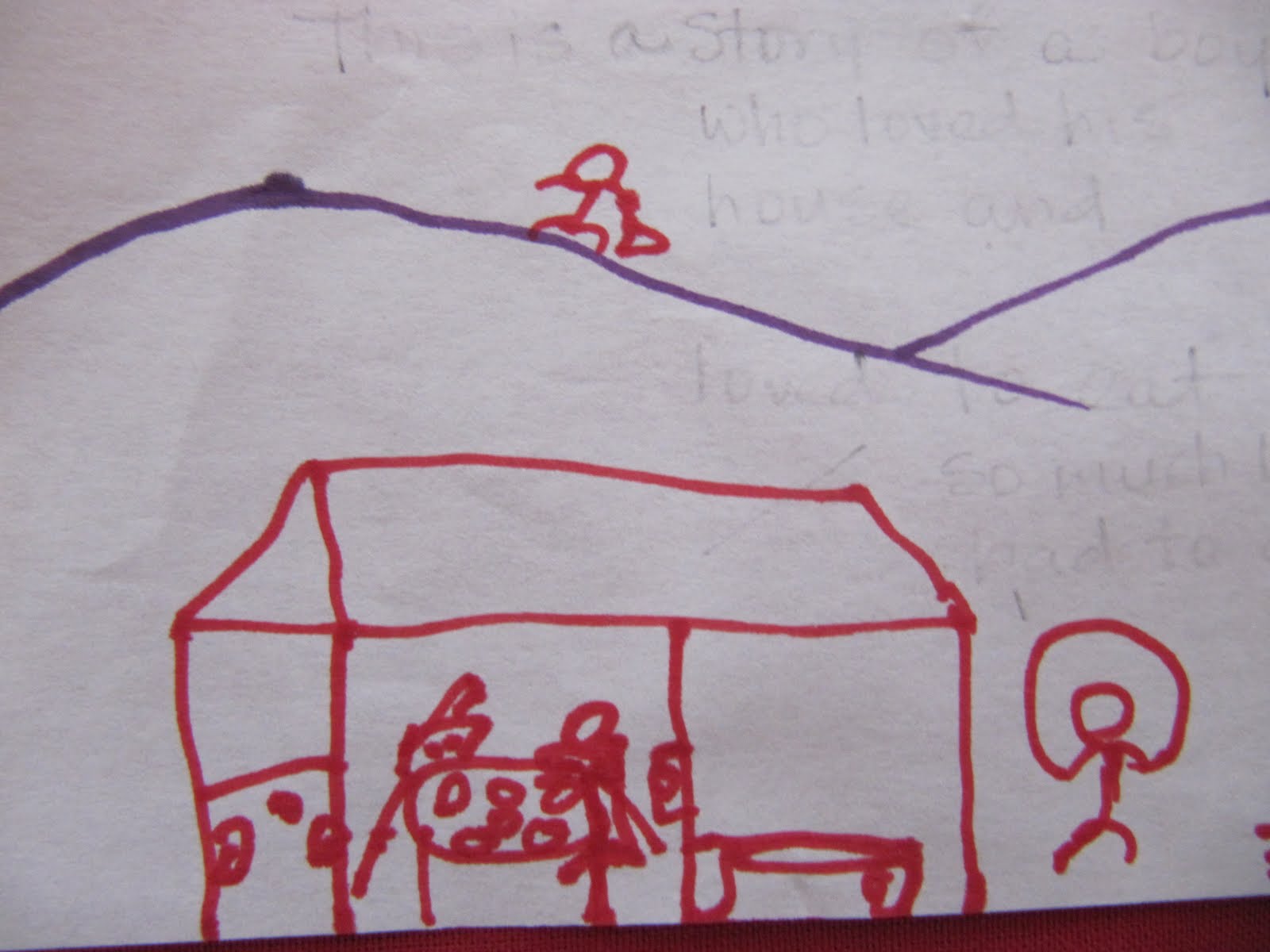
One Burmese refugee boy's journey: "This is the story of a boy who loved his house [in Burma] and loved to eat so much he had to exercise."


A Burmese refugee boy in Kuala Lumpur told and drew this story for his American art teacher at his refugee school. The following 7 posts show the 7 steps in his refugee journey.

Most Burmese refugees have a harrowing, dangerous trip through the Burmese mountains, to escape oppression in Burma. Then, they land in Thailand, and many travel onto Kuala Lumpur, Malaysia where their families are seen as illegal refugees and often exploited but, at least, they can find illegal work in the booming capitalism in Malaysia. But, they land in Malaysia only to feel the same sense of danger and need to hide that they felt back when escaping through the Burmese mountains, followed by men with guns in Burma and men with guns in Malaysia (see drawings below, the men with guns look the same in both the Burmese mountains and Kuala Lumpur).

I have a dream of taking the journey. At least, a safe, expat, more posh version. And, I think Fulbright may make that dream a reality. They have small grants for traveling in this part of the world, and the grants are easy to get. I’d like to go to Burma and see some of the hill tribes that are in Kuala Lumpur as refugees now, the Karen, Chin, and Rohingya Burmese. And, I’d like to travel to northwest Thailand and see the Burmese refugee life there.

Sounds rustic, maybe unsafe, and tough, at first glance, I know, but I know two expat families in KL that have taken their children to both places and it’s do-able. There are “homestays” for a night with Karen refugee families in Chiang Mai, Thailand and for expat families to travel to Burma safely also. Luckily, I can work on selling this trip to Ken knowing that those two parts of the world are among the most beautiful.

One day his family had to go away.

They had to watch out for people who wanted to kill them.

They came to live in Malaysia. A big city with lots of people and cars. It was pretty.

He went to school and church, but the police found them.

The police they took his Dad away.

This boy he has to watch out.


Shoptalk: Fulbright Research -- Ethics and Logistics of Planning Research with Refugee Children


December 18, 2010

Come January, my community partner, Harvest Centre, and I will start Phase 1 of our research. Phase 1 is determining the mental health needs and behavioral issues of the 185 refugee children at Harvest Centre school. Phase 2 is the developing a teacher training program to manage those refugee mental health and behavioral issues in the class.

Harvest Centre was ready to jump right in and start the research the next day, back in November. What a wonderful reversal of roles to have a community partner who’s ready to make a project happen before I am! I couldn’t start right away because I had to (1) Get ethics review board approval from HELP University and (2) Put a research team in place beforehand.

I was working on the ethics review application right up until the last minute, before the Department’s Christmas party. I’d previously had a couple meetings with the head Ethics Review professors, Winnie and Hera, because of the sticky issues surrounding refugee child research. Namely, it is very difficult to get proper parent consent for us to collect information on their children. The refugee kids often don’t live with their parents and their guardians/parents don’t know how to read English. And, the parents almost never come into the school so it’s impossible to get the one-on-one, well-explained verbal and written consent we got back with immigrant parents in Brooklyn schools. Winnie and Hera often use passive consent which involves sending consent forms home with the children and if the parents do not return the consent forms saying NO, then we assume passive agreement from the parents for their children to participate in the study. This is frowned upon back in NYC, although I think it’s used elsewhere in the U.S. Tricky issue, but I feel that I have no choice but to use passive consent, since we can’t get in live contact with the parents. See photo above for a parent who came into another school, the Rohingya Muslim refugee school, to talk with the Malay Muslim teacher of her refugee child.

So, I was relieved to get the consent forms, copies of the measures, and the ethics application done just in time, before I leave town, so my approval should be in place by the team I return in January, ready to interview the refugee teachers about the children’s mental health.

I now have a research lab coordinator and large cadre of interested research assistants from HELP University, since they all want research experience. All these students want to work on this project because it’s the only project at HELP involving low-income children, and refugees are of interest for many of these undergrads.

The plan is for these undergrads to do the interviewing of the refugee teachers. And, some undergrads will enter the data. Also, another HELP professor who specializes in qualitative focus groups, named Anasuya, has offered to run the focus groups with the teachers to get their input on what effective strategies for refugee classroom management we should include in the teacher training manual. Four of the clinical psychology graduate students have also committed to do one-on-one therapy with the refugee children at Harvest Centre and help with the mental health assessments.

Then, we’ll use all the mental health issue and teacher input to adapt an existing teacher training program, called “TeacherCorps,” I worked on at NYU for the refugee classrooms. The plan is to try out the training program on a bunch of refugee teachers from other schools, using our adapted teacher training manual. I can then leave the manual with Harvest Centre and they’ll add this classroom behavior management training to all their existing academic trainings they do with teachers every year. I like this goal of sustainability, after I leave.

Fulbright Teaching and Faculty: End of Semester!


December 16, 2010

I was SO happy to be done with teaching classes at the end of the semester. It’s pretty intense teaching a large 150 person class (see photo above), preparing new lectures every week, even with the help of bits of my old and another professor’s powerpoint slides. To keep their attention for a grueling 2.5 hours of class, it takes every bit of entertainment and activities in me.

Still, I find the process of preparing the lecture to be a near state of “flow,” meaning one in which I lose myself and ideas come to me through a creative process. I’d never really experienced this flow of creative ideas before I’d taught my NYU “Drugs and Kids” class this past spring. Then, the head of the program had encouraged me to let loose and do fun, creative activities to spark the love of learning (and increase enrollment and more $$ in NYU Child Study Center’s pocket). It actually unleashed me in my teaching and I really grew to love the process.

Now, teaching Research Methods here could kill anyone’s flow. Dry subject. A required course for all freshman. Not something the students are excited about, unlike “Drugs and Kids.” But, the topic actually gave a lot of room for creative experiments to be acted out in class, with lots of fun videos of research experiments too. I even found myself dramatically falling to the ground, throwing the quiz papers into the air, and pretending to break my leg for a good 30 seconds – all in the interest of demonstrating a study of social apathy, depending on how close you are to an injury, and to show an experiment using deception. We even then completed a few questions about their reaction to the deception, ran statistics, and got results fitting the hypothesis that those students who were annoyed by my deception were more likely to mistrust future experiments, but only for those students who’d felt seriously deceived in the past, fitting a moderation model technique I’d been teaching them the previous week.

The first photo above was taken by one of my freshman students who asked for a picture of her friends, her, and me on the last class. And, she asked me for a hug. Then, I watched about 15 other girl students from my class line up behind her, all asking for hugs. Some even bowed to me. After this kind of deference, it'll be a rude awakening to return to the cynical shells of NYU undergrads. I don't know if my ego will be able to handle it!

But, thank god the semester was over. I invited some of the other professors to join me for drinks and dinner right after my last class. And, we had such a blast. These ladies are HYPERarticulate! They can talk for 3 hours straight in lecture so sure can chat. And, they have a fun spirit. After a semester together, we all feel like good buddies now. They are Indian Malaysian and Chinese-Canadian professors. The Indian Malaysian professor named Bawany specializes in at-risk street children research for UNICEF, lived in Hong Kong for a while and her husband works for an oil company, with her kids in International Schools. The Chinese-Canadian professor named Hera is living here mostly because her husband is Malaysian, but she often dreams of being back at her former UK university where her colleagues actually wrote papers and did research, with research truly being supported by the institution, unlike at HELP University. She focuses on body image problem prevention. And, the third professor heads the Counseling Psychology program and does brave qualitative research on caning in Malaysian government schools.

We also went to dim sum for lunch during the grading week, with Hera showing me how to finally use a chopstick correctly. She learned the hard lesson that my second grade teacher, Mrs. Hall, learned when she hoped the proper pencil grip she taught me would stick – my hands only seem to hold sticks in certain, disabled ways, leading to horrible handwriting and my constantly dropping the dim sum chicken feet they convinced me to try using the chopsticks. Finally, Hera laughingly called the waiter in Mandarin, asking for forks. The waiter seemed to smile knowingly, like he’d had the fork in his back pocket, just in case.

Shoptalk: Refugee Head Teacher Training


November 21, 2010

If you read my previous blog on refugee children here, it was a dark tale. Refugees in Malaysia are seen as illegal and not deserving of protections or services here, such as school. So, Refugee schools in here are officially illegal and the children in the schools are kept hidden in small apartments upstairs where they have to remain quiet, not disturb the neighbors who threaten to turn them in, and are not allowed to play outside or even play loudly inside, to keep them safe.

For me, the hope I feel is seeing these children in school. As Malaysians here say, in their most vulnerable and emotional moments, the schools are where my “heart” is. And, they usually touch their heart when they say that. I’ve seen the most hardened Chinese Malaysian businessman touch his heart, nearly misting over as he described how volunteering with orphans was where his heart lay.

Harvest Centre, the refugee model school and refugee teacher training center I’ve partnered with, and United National High Commission for Refugees (UNHCR) planned a Head Teacher Training (Head Teacher = Principals who also teach) recently, and they invited me to train them in child behavior management in the classroom. I was thrilled because my main goal for the first half of my Fulbright was to find a community-based partner and have them see me as a resource, with the ultimate goal being to leave some sort of sustainable intervention behind when I leave. And, to have the opportunity to give an overview of the more in-depth, manualized refugee teacher training we were planning for the spring would allow us to get some buy-in and necessary support from the Head Teachers. And, having UNHCR and Harvest Center directors watch my training helped cement our working relationship.

The Head Teachers were almost all refugees themselves, from all over the world. Most from Burma, but some from Somalia, Afghanistan, and East Malaysia. They all had different ways of being in the group. The Somali teacher was loud, forceful, and very focused on the discussion. A Burmese teacher was soft-spoken and systematic in his speech. There were more men than women, and the women let the men take the lead in discussion. Overall, there was a real feeling of deference to me, as the speaker.

I was limited in time, so only hit the high points, without as much interactive, hands-on activities and role plays as I would have liked. But, I was able to do a role play of how to give a time out to a child. See above for a picture of me putting a head teacher in a time out, which gave them a good giggle. I introduced time outs, along with a few other discipline strategies, as an alternative to using the cane, as described in the previous post.

Discussing caning as a discipline strategy was a sensitive topic and even a tough decision to raise at all. I didn’t want them to only remember a white woman wagging her finger at them over caning, which might be the way they take it since they know we Westerners judge them for it. But, I also didn’t want to avoid the topic completely since it’d be the elephant in the room and truly was the only go-to strategy for certain, if not many, of the schools. Really, at the one school I saw using caning, they used caning for everything – from just getting their attention to back-talk to punishment for physical aggression.

I wanted to introduce options like time outs as an alternative to caning. And, so I brought up caning and made it clear that I wasn’t saying it was good or bad. I mentioned that some teachers seemed to feel it was effective and others felt it was ineffective after a certain point of using it or with certain kids who get much worse beatings at home. I went a bit too far, in retrospect, acting out how the teacher from the previous blog post used it slamming the tables with her eyes bulging out. I think that probably seemed disrespectful, on my part. Then, I explained the alternative strategies like time outs.

I asked the teachers to give me feedback at the end on what was helpful and what was not helpful about my mini-training. I wondered if I’d get some reaction to how I brought up caning. One person, I think it was the Somali teacher, said that he found my discussion of caning unhelpful. He said:

“The least helpful topics is ‘no to use cane.’ If you ever dare to call yourself a teacher you should also dare to use cane when it is necessary. There are times, nothing but cane, needs to be used, but with love and prayer. Then only you are a teacher not a cheater.”

I think I get what he’s saying – that a real teacher, like a real parent, takes the child seriously and disciplines seriously, with authority via the cane. And uses love and religion to guide the use of the cane. I’m still figuring out the “cheater” part. In the end, even though only one teacher said he didn’t like the cane part, I think that in the future I will only touch on the cane briefly, acknowledging it and move onto emphasizing the alternative strategies I’d rather they remember.

Another teacher reacted this way to my discussion of positive reinforcement and ways to get the kids’ attention, by doing fun quick games like Simon Says:

“Sometimes, when the teachers are close and make it fun for the students, the respect of the students to the teachers is getting less…how to get students’ respect even though we make fun and friendly to the students.”

That was a great issue to bring to my attention! I think it may end up being one of the biggest cultural obstacles to their being willing to use more positive ways of managing the kids’ behavior – They fear they’ll lose their authority if they use positive strategies.