Sunday, January 2, 2011

Hanoi, Vietnam: Temple of Literature


Tablets with names of Temple of Literature Scholar graduates with top grades.

Confucius

Traditional Vietnamese Music


December 31, 2010

Scholarly pursuits are also revered in Vietnam, in addition to their military leaders. The Temple of Literature schooled scholars for 5 to 7 years, with top graduates getting their names etched into a stone tablet rested on top of a turtle statue, see photo above. Turtles are one of four revered mythical creatures in Vietnam, representing longevity. And, if you look hard at the tablet you can see it was written in Chinese characters, since Chinese was the official language of Vietnam until 1910. We were shocked by that, that Vietnam just up and changed its language to Vietnamese, only 100 years ago.

The Temple of Literature also has a temple where you can pray to Confucius, in the same model as Buddhist temples where you pray to Buddha. A bit surprising to me to see a temple where you pray to a philosophy scholar, but it seems Confucius had a big influence on Vietnamese society, even impacting women's and men's roles: Men should be breadwinners and women taking care of children.

We also saw some traditional Vietnamese music. Click here.

Hanoi, Vietnam: Ho Chi Minh's Presidential Palace

Ho Chi Minh Presidential Palace

Ho Chi Minh's Humble Home

The Lake Ho Chi Minh looked out on.

Ho Chi Minh's bed in his "Bamboo House" on stilts, behind Presidential Palace.
It's next to a bomb shelter for him.

In the photo above is a bomb, to the right of Griffin, that was said to have been shot at Ho Chi Minh's home, but he was protected, safely hidden in his bomb shelter. Griffin is holding a Laotian parchment book that he used to take notes about Vietnam.

December 31, 2010

Ho Chi Minh's Presidential Palace was yet another example of his humility, or so the story is told. The first picture above shows his grand palace with lovely ground, with one long row of mango trees, representing South Vietnam. It is said that once he was in power, on a populist, Mao's political philosophy, some of the politicians beneath him got high on their power, accumulating wealth and grandeur. So, Ho Chi Minh moved out of the grand palace into smaller 2 room homes behind it, leaving the palace for diplomatic functions. He then moved to the "Bamboo House" up on stilts next to his little Koi pond and bomb shelter. His home was actually bombed, it wasn't just paranoia on his part. See the huge bomb shell next to Griffin above.

Hanoi, Vietnam: Ho Chi Minh Memorial


Ho Chi Minh

Our travel agent and tour guide in Hanoi, Tho, with us in front of Ho Chi Minh memorial.

Changing of the guard.

December 31, 2010

I started our day in Hanoi with an early morning run through the lake park in the center of town, just a couple blocks from our hotel. Again, I was hesitant about heading out just after sunrise, so early in a big city. Then, I got to the park and it was packed! Just like in Phnom Penh, but even more vibrant and communal. It made me laugh out loud in joy.

On the sidewalk surrounding the lake there were large groups of people next to music blared through big speakers. There was the typical tai chi and aerobics. But, what was remarkable was the novelty for me of seeing people moving in unison with swords or red fans to traditional Asian music. Some were dancing in woman-woman couples to latin music, wiggling their hips appropriately. There were old and semi-young out there, with everyone seeming like they've known each other for years, having met there every morning at 6am forever and ever.

They can be friendly with their friends, but they sure aren't generally friendly people. Cambodia and Laos people seemed much more warm and friendly, generally. There's a hard-nosed, industriousness that seems to fit with China. Turns out Vietnam means "Southern China," which makes sense. Vietnamese government even changes its policies to fit China's pretty soon after China changes its policies. The government seems to have both tight control over it's country and people while it also allows booming capitalistic entrepreneurship. Socialism is alive and well here, with lots of room for hard work and initiative to make money.

You might wonder how things have changed towards Americans since the Vietnam War. They've changed radically. First, the government started allowing Vietnam Vets back in the country to travel. And, they let back in Vietnamese people who'd moved to the US after the Vietnam War. They'd previously not been let into the country, even as a tourist. After the Americans saw how it was safe for Vietnam Vets and more travel in Vietnam, more Americans came as tourists.

Now, this country is packed with American tourists, along with others. There's no evident hostility towards the Americans or French, although the Vietnam history was told to us with a lot of resentment towards how the French government treated Vietnam when they colonized the Vietnamese. For example, the Vietnamese blame the French for a famine that killed 2 million Vietnamese.

The Vietnamese are not as spiritual people as the Buddhist Cambodians and Laotians, even though the Vietnamese are 70% Buddhist. But, they sure do revere their military leaders, to the point that they pray to them. For real. There's a lovely temple on a lake island in Hanoi where we thought Buddha was being prayed to but it was actually a general they prayed to -- a general who helped free them from the French. In fact, it seems that their adoration and belief in their military leadership has replaced any formal religion here.

But, the biggest military leader they adore and pray to is Ho Chi Minh. He freed the Vietnamese from what they saw as French oppression. There are grand stories told to us about how he cleverly fought a guerrilla war against the French. Above, you can see the Ho Chi Minh memorial, which was the first place our guide took us. There is a changing of the guard there too. Click here to see the video. It's a much simpler, less fancy changing of the guard than we saw in Greece and England, in keeping with the more simple, clean design of most of the government grounds and buildings.

Saturday, January 1, 2011

Luang Prabang, Laos: Riding Elephants through the River


December 30, 2010
Abraham is such a rip-roaring, charismatic, confident kid that he always surprises us when he gets scared. He refused to ride the elephant at first, announcing he'd stay back with our guide. Then, he'd only ride with me in the elephant riding seat. He talked often about how the elephant might drop us or he might fall. He watched Alice confidently slip in front of her mahout (human who teaches and drives the elephant) on top of the elephant's neck to ride on the actual elephant. Our mahout offered to do the same for Boom and he firmly refused.

Our mahout hopped off and helped urge forward Ken, Alice, and Griffin's slow-moving, 45-year-old elephant probably with arthritis, leaving us to ride our elephant with no one driving. So, I was forced to get on the elephant's head by myself to drive, at one point, although the mahout was really in command, yelling out "Pie Pie" to make our elephant, named Venn, move forward. Abraham refused to join me on the elephant's neck.

Finally, he slipped down and sat in front of me, talking a mile a minute, narrating the entire experience, eventually yelling "Pie Pie!" to the elephant to make him go faster. He loved the feel of the elephant's skin, and more so, of being in charge of an animal so much bigger than him.

In the end, Boom was reluctant to return to the elephant site, to hand over the reigns, or really the neck, to the mahout because we were about to take a tricky elephant trek through the river. At the end, Boom hugged his Dad, so proud that he was a mahout, himself, now.

Luang Prabang, Laos: Giving Alms to Monks and the Locals Receive in Return


December 29, 2010

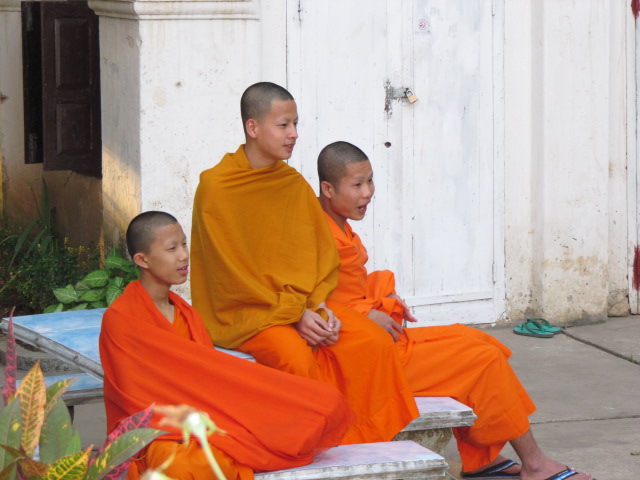
At 5:45 am, I biked down to the center of Luang Prabang for the giving of alms to the Buddhist monks. The monks get fed by the locals in the early morning as part of a giving of alms ritual where locals give rice and more into the silver bowls the monks line up and hold out for alms. At lunch, local women bring food to the temple for the monks. Then, the monks are not allowed to eat the rest of the day, after noon. Our guide, the former monk, explained that he and the other novice monks always knew when a novice had snuck food, after the noon hour, because he went to the bathroom more frequently than the others in the evening. Sounds like they kept a close eye on the bathroom for sport and out of competitive hunger.

The giving of alms is quite a sight at 6:30am. It's actually become quite a tourist event too, with tourists jostling for position for the best camera shot, to the point that the government has signs up in town and the airport telling tourists how to be respectful at the giving of alms. I hesitated about giving alms, feeling like a fraud somehow, and decided to go for it. I was not alone in being a fraud. It's a business with lots of tourists next to me, with someone selling rice, letting me borrow a rice basket, and setting me up with a mat in line with the other tourists (where were the locals???) to give alms.

Then, over 200 monks walked down single-file holding out their silver urns for us to put the rice in. They made no eye contact. I stuck my hand in my rice and was immediately burnt by its steam heat. My fingers still hurt as I type now. So, I practically threw handfuls in as quickly as I could into each of their urns. In minutes, I finished my rice basket, looking to my left and seeing my more knowledgeable neighbor (who'd also coached me to take off my shoes) having only put little, dainty balls of rice into each monk's urn. She had loads of rice left.

I sat awkwardly with an empty basket, with each monk looking at my basket and quickly hurrying by. I felt like I wore a t-shirt named "Buddhist Tourist Fraud" and then embraced my role and took tons of photos and videos in position.

When the line passed me by, which took some time, I walked over to the market looking for the famous, bitter, condensed milk-filled Laos Kafe (coffee), and on my way I found the REAL local alms giving. Click here to see the locals giving alms and turns out they receive a set of chanting prayers in return. And, the locals drips little bottles of liquid onto the street as they bend in prayer in front of the chanting monks.

Ken joked that the official alms giving on main street is just a distracting ruse for tourist to allow the locals to give alms around the corner, in peace, to the sounds of heartfelt monk chanting.

Luang Prabang, Laos: Wat Xieng Thong Buddhist Temple Tour by a Former Buddhist Monk


Phong, our guide, who had been a monk at this Buddhist temple.


The temple music pagoda where they play drums and cymbals once a week, at 4am and 4pm, reflecting an important time in the lunar calendar. Click here for video.


December 28

Our guide, named Phong, had been a Buddhist monk for 8 years of his life, aged 12 to 20. He spent part of that time in a Buddhist wat, or temple, named Wat Xieng Thong, mostly renovating and painting the temple back into shape. He explained to us that Buddhist Monks in Laos are mostly made up of novices, who often agree to be a monk for survival reasons. Monks get free housing, food, and a solid education, including learning English. They can be a monk for as short or long a time as they please. And, they have over 200 rules when they become a full monk, but only 10 as a novice monk. But, they are a tough ten, including no interacting with girls, dancing or drinking beer. Our monk said that as a non-monk he can now have children, marry, and "dance and drink beer!"

His temple was glorious, with its many mosaics shining in the bright sun. The top temple pagoda included an urn of the king and his parents that was paraded on a float through town then the temple pagoda was built around it. Another temple had a buddha that was seen as very powerful but only taken out once a year when most of the city gathered to be near its special powers.

We ended the day by first fortifying ourselves with a nutella crepe then charging up a small mountain to another Buddhist temple and an outrageous sunset overlooking the Mekong river and the mountains surrounding Luang Prabang.

Luang Prabang, Laos: Paper Making


December 28, 2010

Luang Prabang is also famous for its paper making, with mulberry trees as the base. They also add Bougainvillea to the paper for fuschia colorful decoration. The kids saw them boil the mulberry trees, pound it out, got to try their hand at spreading the paper pulp in a strainer frame, and then lay it out to dry. They also showed us how they worked the loom to create gorgeous silk scarves.

I then bought up a storm of paper products and scarves. Gifts to come soon!